
Speed Beats Perfection in Startups: The Real Startup Moat Nobody Talks About
Most startups don’t die because their codebase was messy.
They die because someone else shipped first, learned faster, and captured the market while they were still debating architecture decisions. That’s the uncomfortable truth about early-stage startups, perfect systems rarely win early fast feedback loops do.
A startup with imperfect execution and rapid iteration usually beats a startup with elegant infrastructure built for imaginary scale. Because in the first 12–24 months, your biggest problem is not scaling it’s relevance. In reality, speed beats perfection in startups because markets reward learning speed more than technical elegance.
Why Speed Beats Perfection in Startups
There’s a dangerous obsession in tech startups today, founders want to build like billion-dollar companies before becoming real businesses. This is exactly why speed beats perfection in startups. Teams spend months designing:
- future-proof systems
- scalable microservices
- event-driven architectures
- AI pipelines
- complex DevOps workflows
before validating whether customers even care.
Meanwhile, a smaller team ships a simpler version in 3 weeks, gets real users, iterates aggressively, and owns the market narrative. That’s the difference between engineering for ego vs engineering for momentum. And in startups, momentum compounds faster than architecture.
Why Speed Beats Perfection in Startups for Early-Stage Companies
Most founders think they’re building software. They’re not, they’re building a learning system. Your real job in the early stage is reducing uncertainty as fast as possible by answering questions like:
- Does the market care?
- Will users pay?
- Which workflow creates retention?
- What feature actually matters?
- Which customer segment responds fastest?
None of those answers come from planning. They come from shipping.
Every week spent polishing internal systems before validation delays critical market feedback, and delayed feedback is expensive. Startups don’t usually run out of ideas, they run out of time.
Why Throughput Matters When Speed Beats Perfection in Startups
In AI products especially, speed matters even more because the landscape changes every quarter. The model you spent months optimizing around could become obsolete after the next major release cycle. The startups winning today are not always the ones with the best technology, they’re the ones with the fastest execution loops.
One of the biggest mindset shifts for technical founders is understanding this, output is not the same as throughput. A beautifully engineered feature that takes 3 months to release usually has lower startup value than a “good enough” version shipped in 5 days that produces customer insight immediately.
Throughput creates compounding advantages:
- Faster customer feedback
- Faster iteration
- Faster positioning
- Faster pricing discovery
- Faster retention optimization

How Speed Beats Perfection in Startups During the MVP Stage
A common startup mistake is solving scaling problems before achieving usage. I’ve seen founders design infrastructure capable of handling millions of users while struggling to get their first 500 active customers. That’s not strategy, that’s avoidance disguised as engineering.
The reality is:
- Most MVPs don’t need microservices
- Most SaaS products don’t need Kubernetes
- Most AI startups don’t need custom infrastructure
- Most early products don’t need “perfect” abstractions
What they actually need is:
- customer conversations
- usage data
- retention signals
A simple stack that ships fast often beats a sophisticated stack that slows execution. This is why modern startup stacks like Next.js + Supabase are becoming powerful for MVPs, not because they’re theoretically perfect, but because they reduce decision fatigue and increase shipping velocity. Speed itself becomes leverage.
Why Speed Beats Perfection in Startups More Than Perfect Code
Technical debt can usually be refactored. Market irrelevance is much harder to recover from. This is where many engineering-heavy startups struggle, they fear things like:
- messy code
- shortcuts
- temporary solutions
- duplicated logic
- manual workflows
but ignore the bigger risk, building the wrong product slowly.
A startup can survive ugly code. It usually cannot survive delayed execution while competitors capture users, data, and attention. The best founders know where perfection matters and where speed matters, and that judgment itself becomes a competitive advantage.
Why Speed Beats Perfection in Startups for AI SaaS Companies
Every startup has assumptions, but winning startups validate those assumptions faster than everyone else. That changes everything. A founder who can:
- launch in days instead of months
- test positioning rapidly
- iterate pricing weekly
- improve onboarding continuously
- ship based on user behavior
will usually outperform a technically superior team moving slowly. Because startup markets reward adaptation speed, not architectural elegance.
This is especially true in AI SaaS. Most AI products today are not protected by the model itself. The real moat is:
- workflow ownership
- customer integration
- operational speed
- proprietary usage data
- iteration velocity
The AI layer becomes replaceable faster than founders expect, which is why execution quality increasingly becomes the real differentiator.
The Psychological Reason Speed Beats Perfection in Startups
This is the uncomfortable part nobody likes discussing, sometimes “waiting until it’s perfect” is not discipline it’s fear. Fear of:
- releasing
- feedback
- criticism
- discovering the market doesn’t care
Perfection becomes a psychological safety blanket, especially for technical founders who are more comfortable refining systems than exposing unfinished work to the market.
But startups reward exposure to reality. The founders who improve the fastest are usually the ones willing to look unfinished in public, because every imperfect launch creates learning, and every learning cycle improves the business.
Why Speed Beats Perfection in Startups Through Momentum
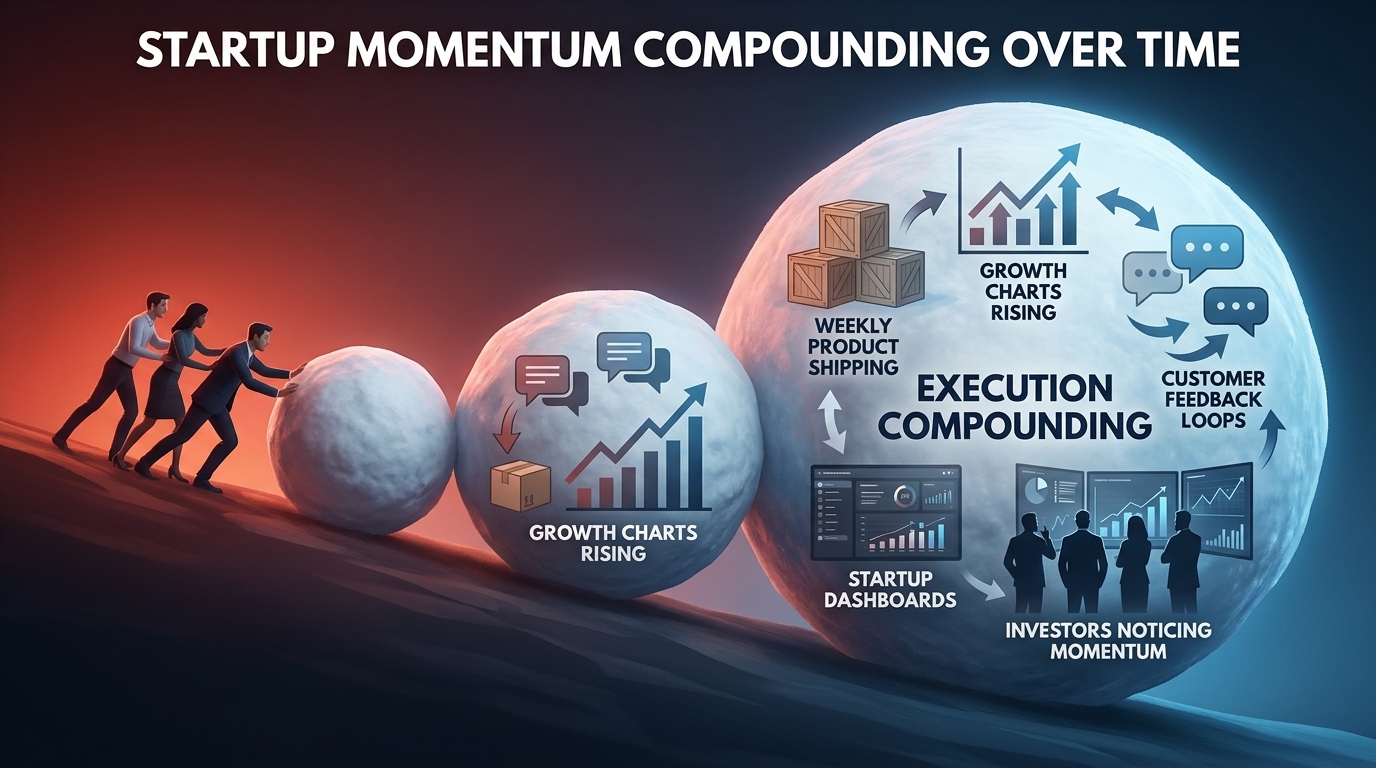
Momentum is one of the most underrated startup assets. When teams ship consistently:
- customers notice
- investors notice
- users engage more
- internal confidence improves
- product intuition sharpens
- distribution becomes easier
Fast-moving startups create energy around themselves, and energy attracts opportunity. The more consistently a startup ships, the more momentum compounds across product, distribution, hiring, and market perception.
A startup shipping weekly learns exponentially more than a startup planning quarterly. Over time, that learning gap becomes enormous, and in startups, accumulated learning often becomes a bigger advantage than accumulated features.
When Speed Beats Perfection in Startups, And When It Doesn’t
Speed does not mean chaos. Good startup execution still requires:
- clean thinking
- prioritization
- product judgment
- operational discipline
- strong fundamentals
The goal is not to build badly, it’s to avoid overbuilding before certainty exists. Great founders know when to optimize for speed and when to optimize for durability.
Early-stage startups usually favor speed, while later stages reward scalability and process maturity. The problem is that many startups prematurely optimize for the later stage before earning it.
The Real Reason Speed Beats Perfection in Startups
“Your startup is competing on learning speed more than coding skill.”
That single idea changes how you build products, prioritize features, hire teams, and execute as a founder. The startups that learn faster usually outperform startups that simply engineer better systems.
Key Takeaways
✅ Early-stage startups win through rapid learning, not perfect systems
✅ Fast feedback loops outperform overengineered architectures
✅ Throughput matters more than polished output
✅ Technical debt is recoverable; market irrelevance often isn’t
✅ AI startups need rapid iteration because the landscape changes fast
✅ Simple, fast-moving stacks create leverage in MVP stages
✅ Momentum compounds faster than perfection
✅ Startup execution is ultimately about reducing uncertainty quickly
Final Thought
Perfection scales established businesses. Speed creates them.
In the early stage, the startup that learns fastest usually wins, even if its systems are less elegant, less polished, and temporarily imperfect. Because startups are not judged by architectural purity; they’re judged by whether they survive long enough to matter.
And if you’re building an AI product, SaaS platform, or startup MVP and want to move faster without overengineering early decisions, let’s talk.