
Why Most AI Startups Will Fail in the Next 3 Years
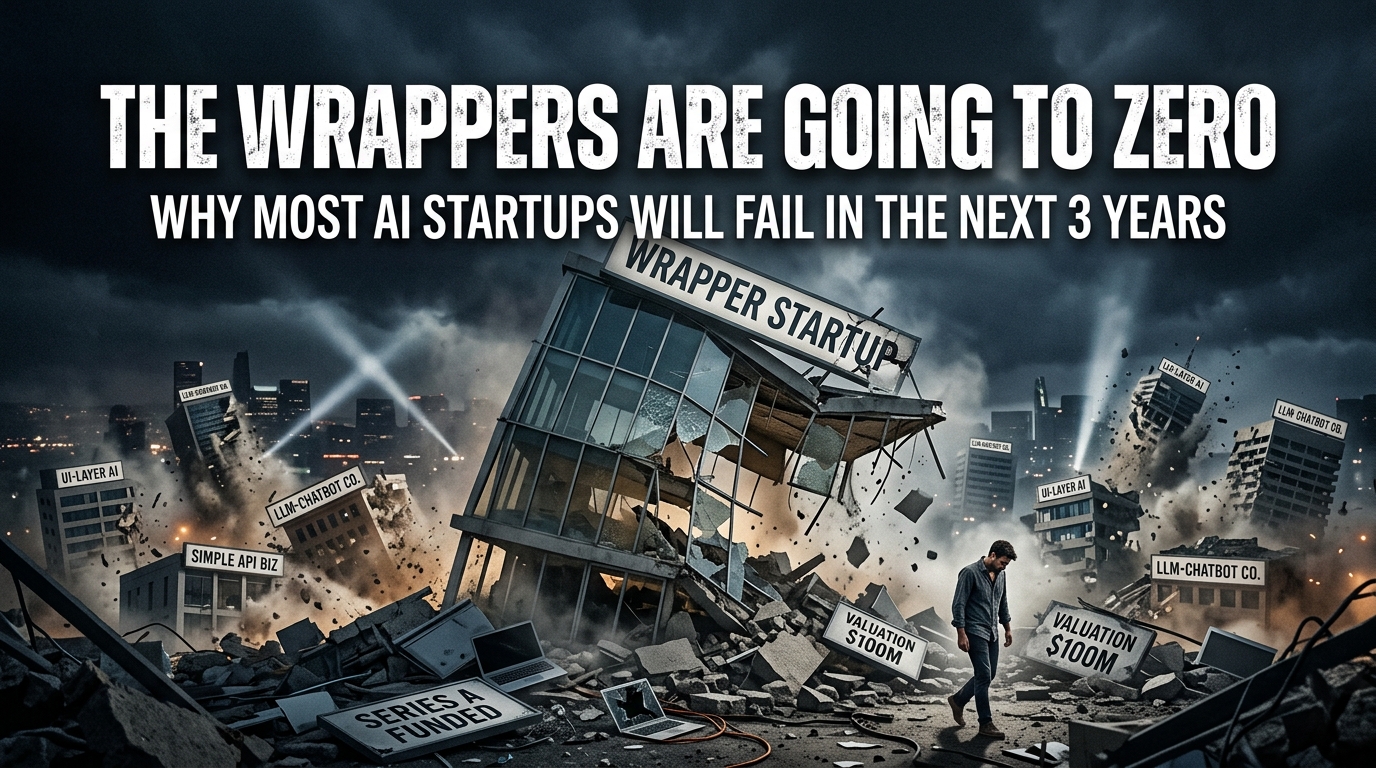
AI startup moat is becoming one of the most misunderstood concepts in the current technology market. Most AI startups are not real businesses, they are temporary UI layers sitting on top of someone else’s intelligence stack. If your entire product depends on wrapping a foundational model with a cleaner interface and a clever prompt, your startup is not a moat, it is a potential feature announcement for OpenAI’s next DevDay.
If your entire value proposition rests on a slick UI and a clever system prompt, you aren’t building an enterprise SaaS company, you are running a temporary UI arbitrage scheme. The AI hype cycle has minted a new generation of founders who mistake API access for a business model.
Right now, hundreds of teams are raising capital to build “X but with AI.” They write a thin TypeScript wrapper, connect it to a Next.js frontend, hook up Supabase, and call it an MVP.
- In 30 days, they have a functioning product.
- In 60 days, they realize five other startups built the exact same thing.
- In 90 days, the foundational model providers release an update that commoditizes their core feature.
Most founders think the AI startup moat is the model itself, when in reality the defensibility comes from workflow ownership, proprietary operational insight, and deep customer integration.
The UI Arbitrage Problem
When you build a shallow feature layer on top of someone else’s intelligence stack, you are making a risky assumption, that the platform provider will never enter your category. History suggests the opposite. Foundational AI companies are incentivized to move up the stack, absorb successful use cases, and commoditize thin application layers the moment they become commercially valuable.
We are already seeing this happen:
- AI writing tools becoming native assistants
- AI coding copilots becoming full IDE systems
- Image generators becoming editing suites
- Chat interfaces becoming workflow agents
- Search becoming execution systems
The AI stack is compressing rapidly. Features that looked differentiated a year ago are becoming native capabilities almost overnight. If OpenAI, Anthropic, or Google can erase your core value proposition with a product update or API release, then you are not building a defensible moat, you are operating on borrowed infrastructure with temporary leverage.
Prompts Are Not the Moat
Many AI startups assume prompt engineering is a defensible advantage. It is not. Prompts alone are not durable intellectual property, especially in a market where models improve faster than most startups can iterate. The same applies to generic RAG pipelines, thin orchestration layers, and shallow AI agent wrappers that can be replicated with minimal effort once the underlying capabilities become standardized.
As models improve:
- Reasoning improves
- Context windows expand
- Multimodal capabilities grow
- Memory systems mature
The value is rapidly shifting away from prompt tricks and toward operational context. The real competitive advantage is no longer how creatively you communicate with the model, but how deeply your product understands the business workflow, the proprietary data it captures, and the operational decisions it becomes embedded within.
- What proprietary data you own
- Where your product sits inside the workflow
- What operational patterns your system understands
- What customer dependency compounds over time
Wrappers are not inherently flawed. In fact, many successful SaaS companies began by simplifying complex infrastructure and improving usability. The problem emerges when the product remains a thin abstraction layer and never evolves into owning the underlying workflow, operational dependency, or customer process that creates long-term defensibility.
The Real AI Startup Moat: Workflow Ownership
The strongest AI startups will not operate as simple utilities that users visit occasionally to generate output. They will evolve into operational systems deeply embedded within how businesses function every day. A utility can be replaced with minimal friction, but a system of record becomes intertwined with workflows, approvals, reporting, and decision-making processes. That distinction is where long-term defensibility begins.
The defensibility comes from:
- Enterprise integrations
- Approvals and compliance flows
- Operational edge cases
- Historical business context
- Human review systems
- Reporting infrastructure
- Switching costs
Anyone can replicate a user interface. Very few companies can replicate years of accumulated operational workflow intelligence, edge-case handling, customer processes, and domain-specific execution logic. That is precisely why vertical AI companies have a much stronger long-term future than generic AI assistants competing solely on surface-level features.
The companies that survive will own deeply embedded workflows in industries like:
- Healthcare
- Logistics
- Finance
- Legal operations
- Manufacturing
- Enterprise procurement

Proprietary Operational Insight
The most valuable AI data is not scraped from the public internet, it is operational telemetry generated inside real workflows. The strongest AI companies learn from user corrections, approval behavior, workflow overrides, escalation patterns, edge cases, and the countless micro-decisions users make while interacting with the system every day.
- User corrections
- Workflow overrides
- Escalation behavior
- Approval patterns
- Internal decision logic
- Edge-case handling
- Customer-specific context
This creates a compounding feedback loop that generic foundation models cannot easily replicate. The most successful AI companies will not compete on raw intelligence alone; they will compete on operational context, workflow understanding, and proprietary behavioral data accumulated over time. That context quietly compounds into a durable operational moat that becomes increasingly difficult for competitors to reproduce.
Distribution Still Wins
The market often assumes the best AI model will dominate, but history suggests otherwise. Distribution, workflow integration, and operational embedding consistently outperform pure technical superiority. An AI startup deeply integrated into a company’s processes, with contracts, reporting systems, employee training, and infrastructure dependencies, will almost always outperform a technically better product that users can abandon in ten minutes.
This is why:
- Switching costs matter
- Workflow dependency matters
- Enterprise trust matters
- Operational embedding matters
The next generation of successful AI companies will not win simply by building smarter systems. They will win by building systems that become deeply embedded into operational workflows, infrastructure, and decision-making processes, systems that are difficult, expensive, and risky for customers to remove.
Final Thoughts
The AI startups that survive the next decade will not win because they wrapped a model faster than everyone else. They will win because they understand operations, workflows, and business systems better than everyone else. The wrappers are going to zero, while the companies owning deeply embedded workflows will continue to scale.
AI itself is rapidly becoming infrastructure. Workflow ownership, operational context, and customer integration are becoming the real AI startup moat for companies trying to build durable long-term businesses. Founders building durable AI businesses need to stop obsessing over prompts and start focusing on workflow depth, proprietary business data, and operational dependency.
That is where long-term defensibility will be built, not in temporary AI interfaces, but in systems businesses cannot afford to remove. If you are building workflow-driven AI products, enterprise SaaS platforms, or operational automation systems, feel free to explore our work or get in touch.