What Is an AI Harness? 7 Essential Ways It Powers Reliable AI Agents
An AI model can understand instructions, generate code, and suggest solutions. But what happens when you ask it to fix a bug, inspect files, run tests, and verify the result? Generating an answer is only one part of completing the task. This is where an AI harness comes in.
An AI harness provides the surrounding system that enables a model to work through tasks using tools, context, execution controls, and feedback. It helps turn model capabilities into a structured workflow rather than a series of disconnected responses.
Why a Prompt or API Call Is Not Enough
A simple LLM integration typically sends a prompt to a model and receives a response. That works well for many applications, but complex tasks require more.
Imagine asking an AI coding agent to fix a login bug in a SaaS application. The model might suggest a code change, but the application still needs to inspect the relevant files, apply the change, run tests, handle failures, and determine whether the fix works.
A prompt alone does not manage that entire process. An AI harness provides the mechanisms needed to coordinate it.
What Is an AI Harness?
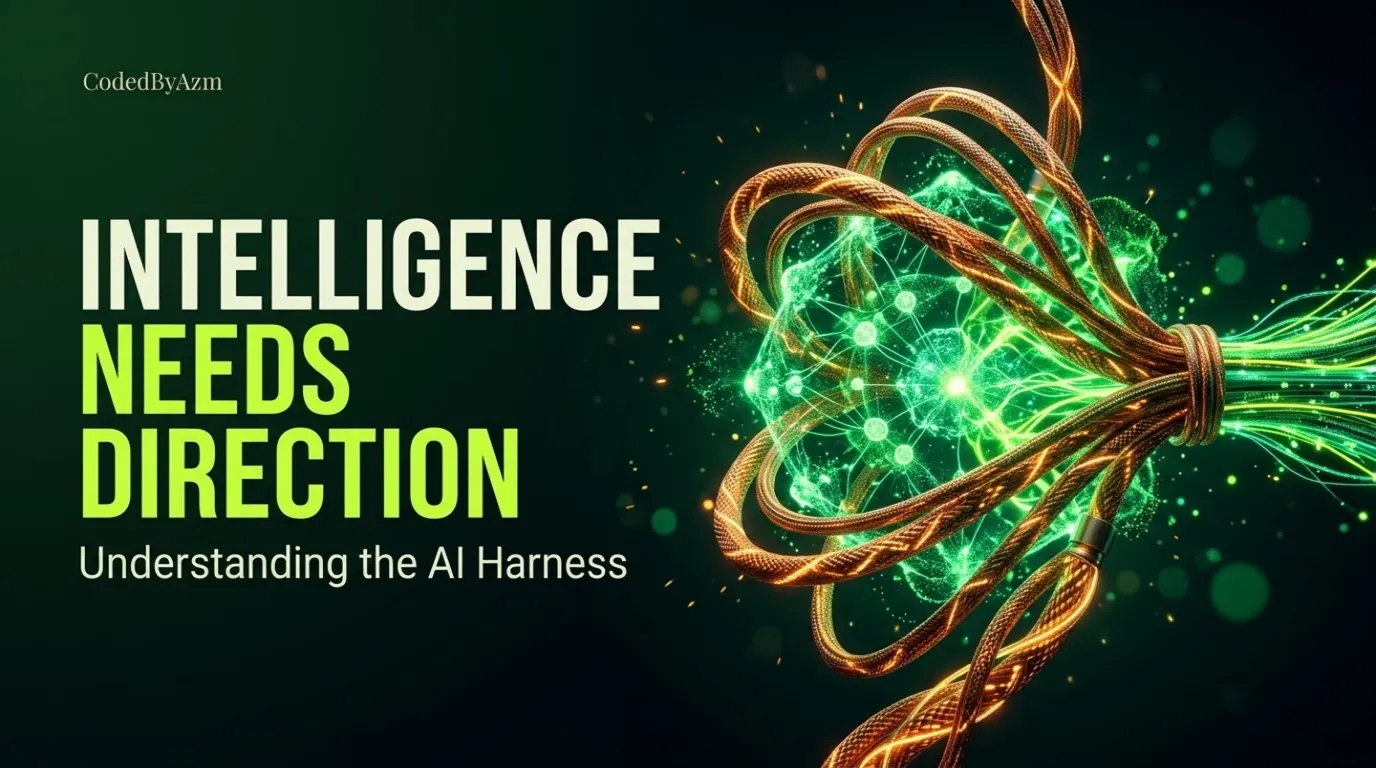
An AI harness is the software infrastructure surrounding an AI model that manages how it receives instructions, accesses tools, executes actions, maintains state, handles errors, and evaluates results.
Think of it as the control system around the model. The model generates reasoning and proposed actions, while the harness manages how those proposals interact with the environment.
An AI harness is not necessarily a separate product or service. It may be built into an agent framework, integrated into an application, or developed as custom infrastructure.
Understanding the Three Layers
The model, harness, and agent work together, but they serve different purposes.
The AI model interprets context and generates responses or proposed actions. The harness coordinates the model’s interaction with tools, data, and execution environments. The agent uses this setup to pursue a goal through multiple steps.
These are conceptual distinctions, not rigid boundaries. In real systems, their responsibilities may overlap.
How an AI Harness Works: 7 Essential Responsibilities
Consider our coding agent tasked with fixing a login bug. The harness supports the workflow through several connected responsibilities.
1. Managing Instructions and Context
The harness supplies the task requirements, relevant code, and constraints the model needs. It may also maintain a record of previous actions and results so the agent can continue without losing track of progress.
2. Connecting the Model to Tools
The model cannot automatically inspect a repository or execute a command just because it knows how. The harness provides controlled access to tools such as file readers, terminals, APIs, and test runners.
When the coding agent needs to inspect the login function, the harness facilitates that tool call and returns the result to the model.
3. Controlling the Execution Loop
An agent often needs multiple model calls and tool executions to complete one task. The harness coordinates this loop: the model proposes an action, a tool executes it, the result returns, and the model decides what to do next.
The process continues until the task is completed, a stopping condition is reached, or the system determines that it cannot proceed.
4. Enforcing Permissions and Safety
Giving an agent access to tools also introduces risk. A coding agent might modify unrelated files, execute a destructive command, or access information it should not see.
The harness can restrict file access, limit permitted commands, require approval for sensitive actions, and enforce execution boundaries. These controls help keep the agent’s actions within defined limits.
5. Handling Errors and Retries
Tools fail, commands return errors, and proposed code changes sometimes break existing functionality. A reliable harness captures these failures and makes the results available to the model.
For example, if the login tests fail after a change, the agent can inspect the test output and attempt a correction. Retry limits and timeouts help prevent endless loops or uncontrolled resource consumption.
6. Maintaining State and Progress
Longer tasks require more than the latest model response. The system may need to track which files were inspected, which changes were applied, which tests passed, and what remains unfinished.
The harness manages this execution state and provides relevant information to subsequent model calls. This is particularly important when a task spans many steps or requires recovery after a failure.
7. Evaluating the Final Result
An agent saying “the bug is fixed” does not prove that it is fixed. The harness can run automated tests, inspect command results, check expected conditions, and record what was verified.
In our example, successful login-related tests provide useful evidence that the change works. They do not guarantee that every possible login issue has been eliminated, so the final report should accurately reflect what was checked.
What Makes a Good AI Harness?
A good AI harness balances flexibility with control. It gives the model the tools it needs without granting unrestricted access, maintains enough context to support multi-step work, and handles failures without allowing execution to continue indefinitely.
It should also make actions observable through logs and execution records. Most importantly, it should distinguish between a task the model believes it completed and a result the system has actually verified.
These engineering decisions often determine whether an AI agent remains a promising prototype or becomes useful in a real application.
AI Harness vs. Agent Framework
An AI harness describes the infrastructure responsible for controlling and supporting model-driven execution. An agent framework provides reusable components and abstractions for building AI agents.
The two are closely related. A framework may already provide tool execution, state management, and control loops, effectively supplying parts of a harness. Developers still need to understand which safeguards and verification mechanisms are provided and which must be implemented separately.
Conclusion
Building an AI agent involves more than connecting an LLM to a prompt. The model provides the intelligence, but the surrounding system determines how that intelligence is applied, controlled, and evaluated.
An AI harness brings these responsibilities together, helping agents work through multi-step tasks with better control, visibility, and verification.
In the next article, we’ll move from concepts to implementation by building a small AI coding agent and exploring its harness in action.
Building AI-powered products? Get in touch with CodedByAzm to discuss AI integration, agent architecture, and SaaS product engineering.