
The Rise of the 3-Person Billion-Dollar Company
The next 3-person billion-dollar company probably won’t have 5,000 employees.
It will likely have five dashboards, three operators, a highly automated workflow stack, and an almost obsessive focus on execution speed. That sounds unrealistic only if you still think startups scale the same way they did ten years ago.
For decades, companies grew by adding people. More engineers, more managers, more departments, and eventually more operational layers. That model made sense when execution depended almost entirely on human coordination. If you wanted to move faster, you hired more people. If you wanted to support more customers, you built larger teams.

But AI is quietly changing the economics of company building. Not because prompts suddenly replace expertise or because AI turns average operators into exceptional founders. The real shift is much more practical. Modern tooling is eliminating operational friction at a scale most people still underestimate. And operational friction has always been the hidden tax that slows startups down far more than technology itself.
The Death of Coordination Overhead
For the last twenty years, the startup playbook looked almost identical everywhere.
- Raise capital
- Hire aggressively
- Expand teams
- Build management layers
- Scale through headcount
The assumption behind this model was simple, growth requires more people. More customers meant more support staff. More product complexity meant larger engineering teams. More scale meant more managers, more processes, and eventually more organizational layers.
But that assumption is starting to break.
AI tooling, workflow automation, composable infrastructure, and cloud-native systems are fundamentally changing how modern startups operate. A lean technical team today can generate the kind of output that previously required entire departments. Not because humans are becoming irrelevant, but because modern systems are dramatically reducing the amount of coordination required to execute.
And coordination overhead is what quietly kills momentum inside growing companies.
Every additional layer creates:
- more meetings,
- more approvals,
- more communication chains,
- more project dependencies,
- and slower execution.
At some point, companies stop moving like startups and start moving like governments. Decision-making slows down, execution becomes fragmented, and simple problems suddenly require multiple teams to solve. The dangerous part is that this transition usually happens much earlier than founders expect.
Most Startups Never Die Because of Engineering
One of the biggest misconceptions in startup culture is that technology is usually the primary bottleneck. In reality, most startups do not fail because they are unable to build products. They fail because execution slows down faster than learning speeds up. As companies grow, operational complexity begins to expand exponentially, and that complexity quietly becomes the biggest threat to momentum.
What starts as a fast-moving team eventually turns into layers of coordination. Small product decisions suddenly require cross-functional alignment, sprint planning meetings, stakeholder reviews, approvals, documentation cycles, and endless context switching. Over time, the organization becomes slower than the market it is trying to compete in. And in startups, that delay can be fatal because markets move faster than internal processes ever will.
That’s the real danger. Speed compounds in startups, but so does friction. This is why small, highly focused teams often outperform much larger organizations despite having fewer resources. Smaller teams maintain clarity longer, communicate faster, and iterate without heavy operational drag. And now, with AI-assisted workflows and automation layers, lean teams can operate at a scale that previously required entire departments.
Startups Are Becoming Systems Instead of Teams
Traditional companies scale through headcount. AI-native companies scale through systems. That distinction matters far more than most founders currently realize because it fundamentally changes how startups operate, hire, and grow.
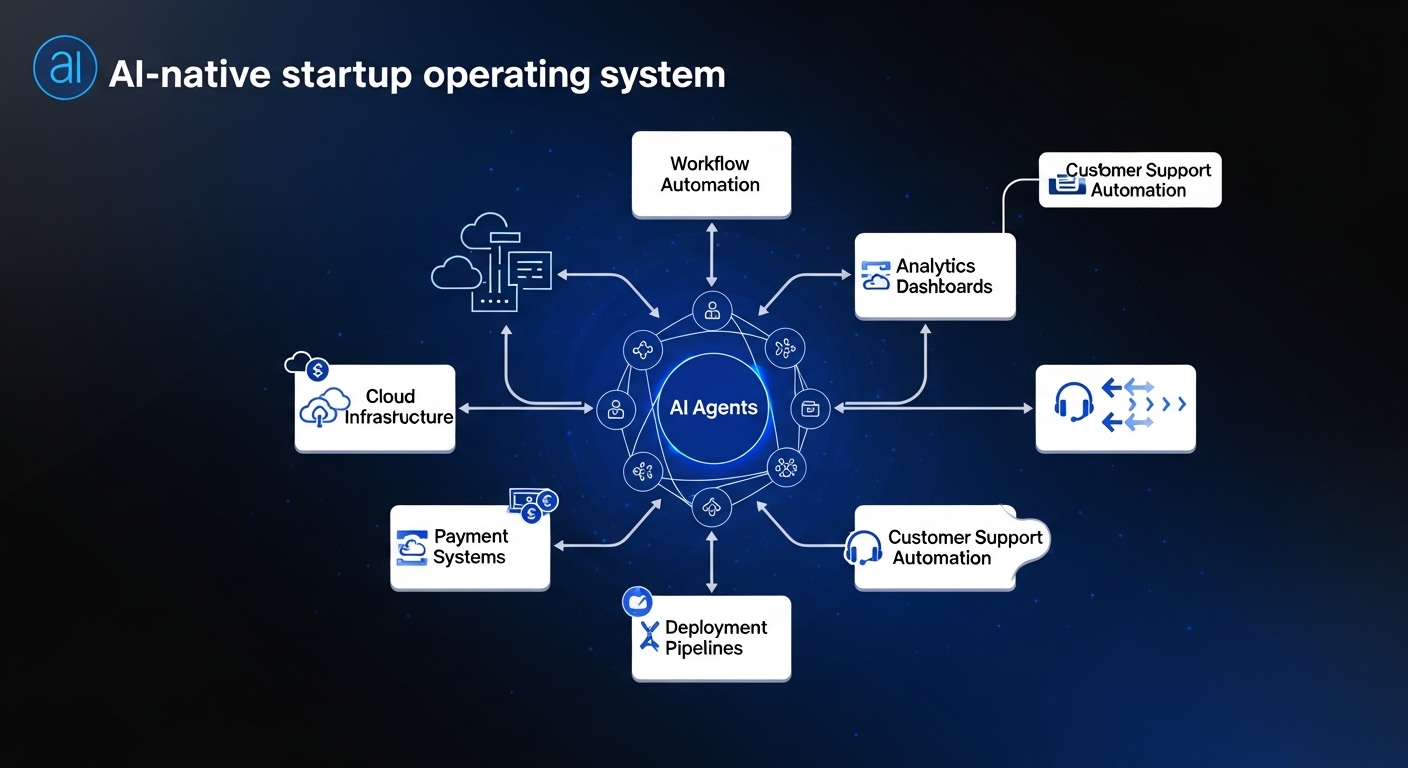
A modern startup stack today can include:
- AI-assisted development workflows,
- automated QA pipelines,
- self-healing infrastructure alerts,
- workflow orchestration using tools like n8n or Make,
- AI-generated documentation,
- automated onboarding systems,
- AI customer support layers,
- autonomous analytics reporting,
- and deployment pipelines that require minimal manual intervention.
What makes this shift important is that small teams no longer spend most of their time handling repetitive operational work. The systems increasingly handle it for them. Tasks that previously required dedicated operations, support, QA, analytics, or onboarding teams can now be heavily automated and managed through lean infrastructure layers.
Operationally, this allows a three-person startup to behave like a fifty-person company. Not culturally or emotionally, but operationally. That is a massive shift because startups are no longer constrained purely by team size. They are increasingly constrained by how intelligently they design systems, workflows, and execution pipelines.
The New Startup Moat Is Execution Density
For years, startup moats were built around:
- funding
- hiring power
- engineering scale
- and distribution advantages
Those advantages still matter, but the landscape is shifting. Increasingly, the real moat is becoming execution density, the amount of high-quality output a company can generate per employee. In the next decade, that metric will likely matter far more than raw team size because modern startups are no longer limited by access to infrastructure alone. They are limited by how efficiently they can execute.
A lean startup with:
- strong automation
- AI-native workflows
- composable infrastructure
- and ruthless product focus
Can now outperform competitors burning millions on operational overhead and bloated coordination structures. Small teams can iterate faster, deploy faster, and adapt faster because fewer layers exist between decisions and execution.
This is one reason modern technical founders are becoming extremely dangerous competitors. They can move from idea to deployment faster than many legacy organizations can finalize a roadmap discussion. In a market where speed compounds, that execution advantage becomes incredibly difficult to defend against.
This is exactly why the rise of the 3-person billion-dollar company is becoming operationally realistic rather than just startup theory.
AI Is Reducing the Cost of Iteration
Most people focus heavily on AI-generated code. Ironically, that is probably the least interesting part of what is happening right now. The real power of AI is not just that it helps developers write software faster, it’s that it dramatically reduces the cost of iteration across the entire startup lifecycle.
Ideas that previously required:
- a funded engineering team
- six to twelve months of development
- and massive operational coordination
can now be validated in weeks. Founders can move from concept to prototype, gather feedback quickly, refine positioning, and test assumptions without building large teams or spending enormous amounts of capital upfront.
This changes startup dynamics completely. A founder can now launch multiple serious product experiments before a traditional company finishes internal planning meetings and roadmap alignment sessions. That creates a massive competitive advantage because startup success is often less about initial brilliance and more about learning speed.
The faster a company can test assumptions, gather real-world feedback, and adapt its product strategy, the higher its survival probability becomes. AI aggressively accelerates that feedback loop, allowing lean teams to iterate at a speed that would have been operationally impossible just a few years ago.
Faster iteration cycles are one of the biggest reasons a modern 3-person billion-dollar company is now technically possible.
Composable Infrastructure Quietly Changed Everything
Another underrated shift happening right now is the rise of composable infrastructure. Modern founders no longer need to build every foundational layer from scratch before launching a serious product. The infrastructure ecosystem has matured to the point where startups can assemble powerful systems far faster than ever before.
Today, startups can plug into platforms like Stripe for payments, Supabase for backend infrastructure, and workflow automation systems like n8n instead of building every operational layer internally.
- managed databases
- authentication providers
- payment systems
- cloud storage
- AI inference APIs
- vector databases
- serverless infrastructure
- analytics platforms
- and workflow engines
As a result, the startup stack has become highly modular. Founders are no longer spending months reinventing infrastructure layers that already exist. Instead, they are focusing more on product logic, workflow optimization, customer experience, and execution speed.
The best technical founders today are no longer just software developers. They are becoming infrastructure composers. Their advantage comes from intelligently combining systems, automations, APIs, and workflows into highly efficient operational machines that can scale without requiring massive teams behind them.
That’s a very different skill set from traditional software engineering. The leverage now comes less from writing every line manually and more from designing systems that maximize output while minimizing operational friction.
Composable infrastructure is one of the foundational reasons the 3-person billion-dollar company can realistically exist in the AI era.
The Future Founder Is Part Engineer, Part Operator
The next generation of technical founders will look very different from the previous era. Traditional startup ecosystems operated with clearly separated responsibilities where engineers built systems, operators managed workflows, analysts handled insights, support teams managed customers, and managers coordinated execution across departments.
Earlier startup structures depended heavily on specialization:
- engineers built systems,
- operators handled workflows,
- analysts managed insights,
- support teams handled customers,
- and managers coordinated execution.
But those boundaries are now starting to collapse. In lean AI-native companies, founders can no longer afford to think in isolated functional silos because operational leverage increasingly comes from understanding how the entire system works together.
Modern founders now need to understand:
- systems design
- automation architecture
- infrastructure economics
- product psychology
- workflow optimization
- AI tooling
- and operational bottlenecks
This shift matters because in lean companies, inefficiencies become visible immediately. There are no extra layers available to absorb bad processes, poor communication, or operational waste. Broken systems surface quickly, which forces founders to think more holistically about execution, automation, and scalability from the very beginning.
AI Does Not Replace Thinking
There’s also a dangerous misconception spreading through the startup world right now. Many people assume AI automatically creates successful businesses simply because it lowers the barrier to building products. But that assumption misses the bigger picture entirely.
AI does not create great companies on its own. It amplifies velocity, not wisdom.
If your product instincts are weak, your positioning is unclear, or your understanding of customer problems is shallow, AI simply helps you execute bad decisions faster. That’s the uncomfortable reality many founders are starting to discover. Faster execution only becomes an advantage when the underlying direction is correct.
AI removes friction, but it does not replace judgment. Strategic thinking, product intuition, customer empathy, and execution discipline still matter enormously. In many ways, they matter even more now because when everyone has access to similar tools, the real differentiator becomes the quality of decisions, not just the speed of execution.
The Future Belongs to High-Leverage Teams
This shift does not mean large organizations suddenly disappear overnight. Enterprise companies will continue to dominate areas that require enormous scale, deep institutional trust, and long-term infrastructure investment.
Large companies still maintain significant advantages in:
- global distribution
- regulatory environments
- massive infrastructure ownership
- and institutional relationships
But startup formation itself is changing rapidly. The economics of building software companies are no longer the same as they were even a few years ago. Modern startups can launch faster, operate leaner, and scale globally without building massive organizational structures early on.
The next generation of SaaS companies will likely:
- stay lean longer
- raise less capital initially
- automate aggressively
- optimize for profitability earlier
- and operate globally from day one
The companies that win in this environment will not necessarily be the ones with the largest teams. They will be the ones with the highest leverage, the fastest execution cycles, and the least operational friction. That is why the idea of a 3-person billion-dollar company no longer feels unrealistic. From an operational perspective, it is becoming increasingly possible.
Key Takeaways
- AI reduces operational friction more than engineering effort alone.
- Modern startups scale through systems, not headcount.
- Workflow automation dramatically increases execution speed.
- Composable infrastructure allows founders to move faster with smaller teams.
- Execution density is becoming a stronger moat than company size.
- AI lowers the cost of iteration and product validation.
- Technical founders are evolving into systems architects and operational operators.
- AI amplifies execution quality — not strategic thinking.
Closing Thought
For years, the startup ecosystem glorified large teams, massive funding rounds, and aggressive hiring as the ultimate indicators of success. Growth was often measured by headcount rather than operational efficiency. But the next generation of iconic companies may look completely different.
The companies defining the AI era will likely operate with smaller teams, sharper systems, higher leverage, and far less operational noise. Their advantage will not come from having the most employees or the biggest organizational structures. It will come from moving faster, automating intelligently, and eliminating friction across execution layers.
Because in the AI era, the companies that win may not be the ones with the largest teams. They may simply be the ones with the least operational friction.
If you’re building AI products, SaaS platforms, or lean startup systems and want to discuss product strategy, automation architecture, or scalable execution workflows, you can connect with me.